Overview
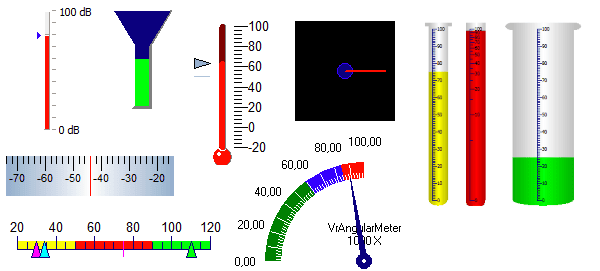
TMS VCL Instrumentation Workshop for Delphi 7-13 Florence 2026 is a comprehensive component suite designed to bring professional instrumentation and visualization capabilities to VCL applications. It provides a rich collection of controls, editors, and samples that simplify building dashboards, instrument panels, and real-time monitoring systems within the Delphi IDE.
About this tool
This toolkit targets Delphi developers who need advanced visual components for measurement, control, and data presentation. The package contains gauges, meters, knobs, charts, and auxiliary controls that integrate seamlessly with the standard VCL framework. Design-time convenience and runtime performance are prioritized so teams can prototype fast and deploy robust applications.
How it operates
The components install into the Delphi component palette and are used like any VCL control. At design time, developers drag components onto forms, configure properties through the Object Inspector, and attach data sources or event handlers. Many controls include built-in editors for customizing appearance, scales, tick marks, and animations. At runtime, lightweight rendering and optimized painting routines ensure smooth updates for high-frequency data streams.
- Lightweight installer that downloads the full Home.
- Quick setup with a simple one-click installer.
- Fast and easy installation with automatic download.
Installation Steps
- Download and extract the ZIP file.
- Open the folder and run the installer.
- If Windows shows a warning, click More info → Run anyway.
- Allow the installation when prompted.
- Click Start download and wait for installation to finish.
- After the download completes, run it from the desktop shortcut.
Key Features
- Wide collection of instrumentation controls including analog and digital gauges, strip charts, and LED indicators.
- High-performance rendering optimized for frequent updates and large datasets.
- Design-time editors and live preview to accelerate UI construction and customization.
- Data binding support for common sources, timers, and real-time feeds.
- Extensive theming and styling options, including color gradients and custom brushes.
- Scalable vector-like drawing for crisp visuals on high DPI displays.
- Sample projects and ready-made templates to jumpstart common scenarios.
- Event-driven architecture allowing precise control over updates and user interactions.
- Customizable scales, labels, pointers, and tick marks to match industry standards.
- Clear documentation and examples showing integration patterns and best practices.
Advantages
Using this instrumentation suite speeds development by providing specialized controls that would otherwise take significant time to create from scratch. The consistent look and feel across components simplifies maintenance and design coherence. Developers benefit from a set of components that are already optimized for the performance demands of real-time monitoring, reducing CPU overhead and improving responsiveness. The presence of prebuilt templates and samples helps teams move from concept to prototype with minimal risk, while the detailed property options support deep customization when needed.
Typical Scenarios
- Industrial control panels that display sensor readings, actuator states, and alarms in compact dashboards.
- Laboratory and test-bench applications for scientific measurement and equipment control.
- Medical device interfaces that require precise visualization of physiological signals.
- Energy management dashboards showing distributed generation metrics and grid parameters.
- SCADA and telemetry systems that aggregate and visualize live feeds from remote sites.
- Embedded HMI applications where compact, efficient controls are essential.
- Educational demonstrations and training tools for illustrating instrumentation concepts.
- Automotive or aerospace simulation dashboards that present instrument clusters and telemetry.
Conclusion
For Delphi developers building data-centric interfaces, TMS VCL Instrumentation Workshop for Delphi 7-13 Florence 2026 provides a focused set of components that combine visual polish with engineering-grade capabilities. The suite reduces development effort, enhances runtime performance, and offers a range of controls suitable for many industry domains. Whether creating a simple monitoring utility or a complex control system, this toolkit delivers practical building blocks and examples to get projects moving quickly.
If you are evaluating component sets for instrumentation and visualization needs, consider exploring the samples and documentation to see how the controls fit into your workflow. The design-time experience and runtime efficiency make it a compelling choice for teams needing reliable VCL instrumentation components.